Our activities are partially covered either by the Slovak Scientific Grant Agency (VEGA) or by the Slovak Government.
Projects
- Projects of Slovak Scientific Grant Agency VEGA:
Number Principal Investigator Name of project 2/5137/25 P. Stríženec The hadronic energy calibration in the ATLAS calorimetry - the proposal and software implemantation, the assembly, testing and updrade of the electronics 2/4067/24 J. Ferencei Study of ep collisions in H1 experiment in the conditions of the HERA increased luminosity 2/6192/26 I. Králik Study of nuclear matter at extremal conditions in NA57 and ALICE experiments in CERN 2/0061/08 D. Bruncko The study some aspects of the calorimetry in high energy physics 2/0100/08 J. Bán The proposal and the radiation hardness tests of the speed electronics based on the SiGe technology and working in the wide temperature region for collider's experiments with high luminisity - Slovak government projects:
Number Principal Investigator Name of project CERN-ALICE L. Šándor Study of new forms and phase transition of nuclear matter at at high energy densities. Contribution to the development and building of the electronics for silicon pixel detector (SPD) and for central trigger system of the ALICE experiment CERN-ATLAS D. Bruncko Development and tests of the calibration system for hadronic end-cap calorimeters for ATLAS detector in CERN CERN-NA57 I. Králik Study of possible quark-gluon plasma production in heavy-ion collisions
- INTAS project:
Number Principal Investigator Name of project 05-103-7555 D. Bruncko A Proposal for R&D to establish the limitations on the operation of the ATLAS End-Cap Calorimeters at high LHC Luminosities
- APVV project:
Number Principal Investigator Name of project APVV-20-057305 J. Antoš The advanced top quark physics studies
Heavy-ion physics experiments
The main goal of the heavy ion activities is finding an experimental evidence of a possible formation of the new state of matter -- Quark Gluon Plasma -- and investigation of properties of nuclear matter under extreme conditions (high temperatures, high densities). A list of the selected activities and results:
-
Experiments with Pb ions at the CERN SPS
- Results on inverse
m
 slopes of different particle
species in Pb-Pb collisions at 160 AGeV/c
can be interpreted
as an indication of the collective transverse flow in heavy
ion collisions. WA97 results on
slopes of different particle
species in Pb-Pb collisions at 160 AGeV/c
can be interpreted
as an indication of the collective transverse flow in heavy
ion collisions. WA97 results on
 (and probably also
 ) show deviation from the trend followed by particles with
zero or one unit of strangeness (see fig. 1).
This suggests that multistrange baryons (and antibaryons) are
produced in hot and dense central fireball and their production
is not much affected by the later hadronic rescattering.
) show deviation from the trend followed by particles with
zero or one unit of strangeness (see fig. 1).
This suggests that multistrange baryons (and antibaryons) are
produced in hot and dense central fireball and their production
is not much affected by the later hadronic rescattering.
- Dependence of the hyperon yield on the collision centrality is tried as a promising tool for establishing conditions for possible transition of nuclear matter into a new regime (see fig. 2 with the WA97 results).
- A new experiment NA57 continues studying the strange particle
production in heavy-ion collisions. New aims of this experiment
include enlarged centrality coverage (compared with the WA97)
and running with Pb beam at lower energy (about 40 GeV/c
per nucleon).
----------------
WA97 finished data taking in 1996 and the data analysis is in the progress. NA57 had been commisioned in 1997 and started data taking for physics in 1998.
- Results on inverse
m
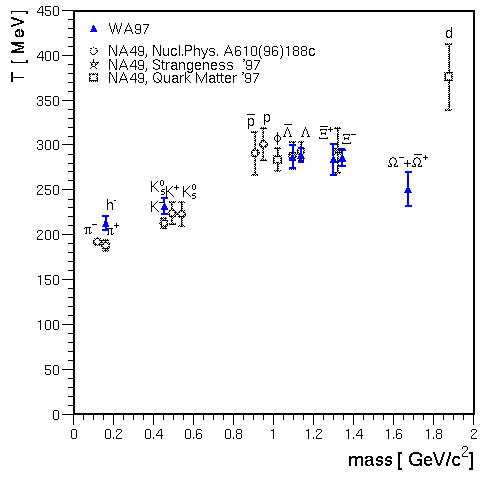
Figure 1: Inverse m
slope parameters T for different particle
species. Linear dependence of the T parameter on
particle mass was suggested as an evidence of the collective
transverse flow in Pb-Pb collisions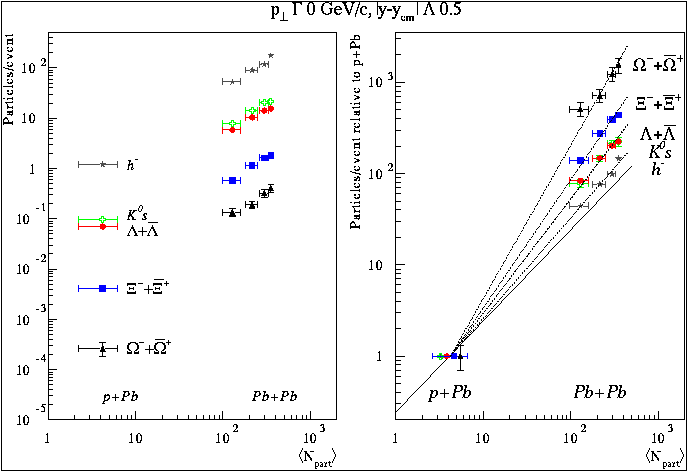
Figure 2: Hyperon yields as a function of the number of participating nucleons (left) in Pb-Pb interactions. The righthand figure shows the same with all yields normalized to those measured in p-Pb collisions. Dotted lines show the deviation of the observed dependence from the assumption about linear dependence of particle yields on the number of participating nucleons (solid line)
-
Other experiments
- Observation of the increase of
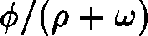 ratio in
S-W compared to p-W collisions (HELIOS-3);
ratio in
S-W compared to p-W collisions (HELIOS-3);
- Finding a ''low mass excess'' in S-W dimuon data which suggests a partial chiral symmetry restoration in nucleus-nucleus collisions (HELIOS-3);
- Observation of the increase of
The heavy-ion subject will be continued in the future on the CERN LHC at the ALICE experiment. At present, various simulations are being performed in order that the detector performance might be optimized. Calculations of radiation conditions in and near the detector are part of our ALICE activities.
Another area of our interest covers design and development of the trigger and data acquisition schemes, which are tested as a part of the NA57 experiment.
H1 experiment
H1 experiment has profited from the significant increase of the collected luminosity in the last 2 years (1996 - 10 pb-1, 1997 - 28 pb-1. This high statistics allowed first deeper look into high Q2 physics and even into physics beyond Standard Model.
The most important results are:
- in 1997 the results of the analysis of the 1995 data taken with
interaction vertex shifted by 70 cm and with an upgraded backward part of
the H1 detector (new Spacal calorimeter and backward drift chamber), were
published for the kinematical range 0.35 < Q2 < 3.5
GeV2, x > 6.10-6 and 0.03 < y <
0.75 [1].
Data show smooth continuation from fixed
target measurements, see fig. 3.
The rise of F2 with decreasing
x is still prominent
for values of Q2 > 2 GeV2 but becomes less steep for smaller
Q2 values.
Data access the transition region from DIS to photoproduction and a provide powerful constraints on the development of further low Q2 phenomenology.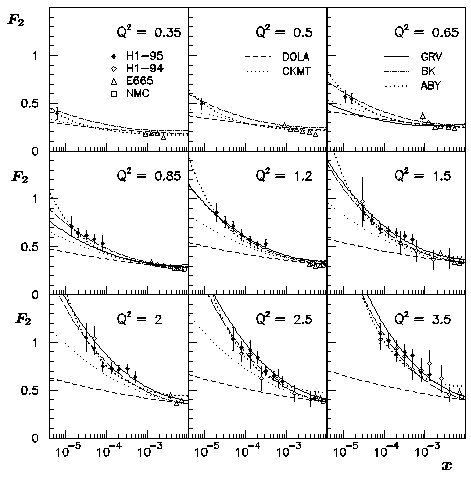
Figure 3: F2p(x,Q2) as a function of x for the different Q2 values - The cross section measurement at high inelasticity values of y
 0.86 was used for the first determination of the longitudinal
structure function FL. FL was derived under the assumption
that F2 measured at low y (y < 0.35) and
extrapolated at high values of inelasticity y is
accurately determined by the NLO QCD calculation. Most of the data are higher
han the QCD expectation but the experimental errors are still relatively
large.
0.86 was used for the first determination of the longitudinal
structure function FL. FL was derived under the assumption
that F2 measured at low y (y < 0.35) and
extrapolated at high values of inelasticity y is
accurately determined by the NLO QCD calculation. Most of the data are higher
han the QCD expectation but the experimental errors are still relatively
large.
- two indications of the signals physics beyond Standard Model were widely discussed. Despite the present interpretation of slight excess in high Q2 region (see fig. 4) with respect to expectations of the Standard Model to be most probably statistical fluctuation, the final answer waits still for more accumulated luminosity.
Second signal indicating the yield of events with one isolated high-pT lepton above the expectation of Standard Model also waits for increased accumulated luminosity of the coming years.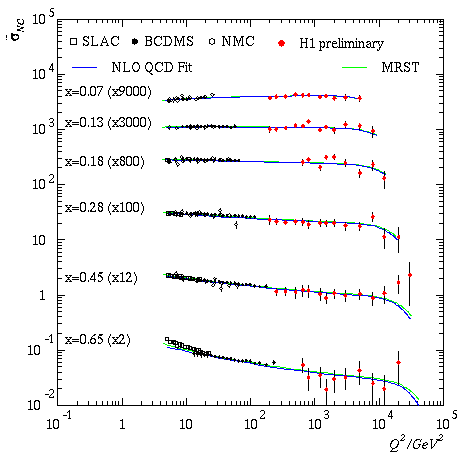
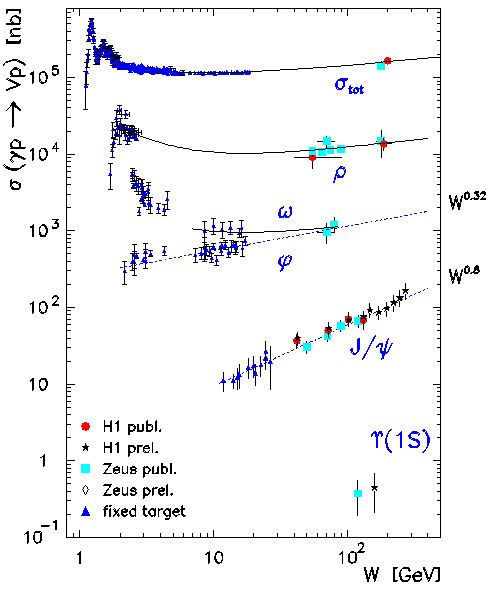
Figure 4: Neutral current cross section at fixed x versus Q2 together with the NMC, SLAC and BCDMS data and compared to the MRST parametrisation and the NLO fit all the data for x > 0.7 - a lot of new results accumulated during the last two years shed the light onto the mechanism of light and heavy vector meson production in photo-production. Figure 5 summarizes the energy dependence of the elastic vector meson cross-sections compared to some power law dependences. In the case of light vector mesons (
 )
the weak dependence on
)
the weak dependence on
 center-of-mass energies
 is consistent with the
exchange of a
soft Pomeron. For the photo-production of
is consistent with the
exchange of a
soft Pomeron. For the photo-production of
 the dependence on
is much stronger and is described by QCD based models.
the dependence on
is much stronger and is described by QCD based models.
- The cross section measurement at high inelasticity values of y
Our contribution is connected with the trigger and ToF systems. -
 p
system
p
system